Healthy Lifestyle11 min read
Sugar vs Jaggery vs Honey: Which Is Really Better?
Sugar, jaggery and honey are commonly used sweeteners in Indian households, but are they really different when it comes to health? Understand their nutritional value, calorie content, effect on blood sugar and practical uses to make informed choices without falling for common sweetener myths.
Sugar vs Jaggery vs Honey: Which Is Really Better?
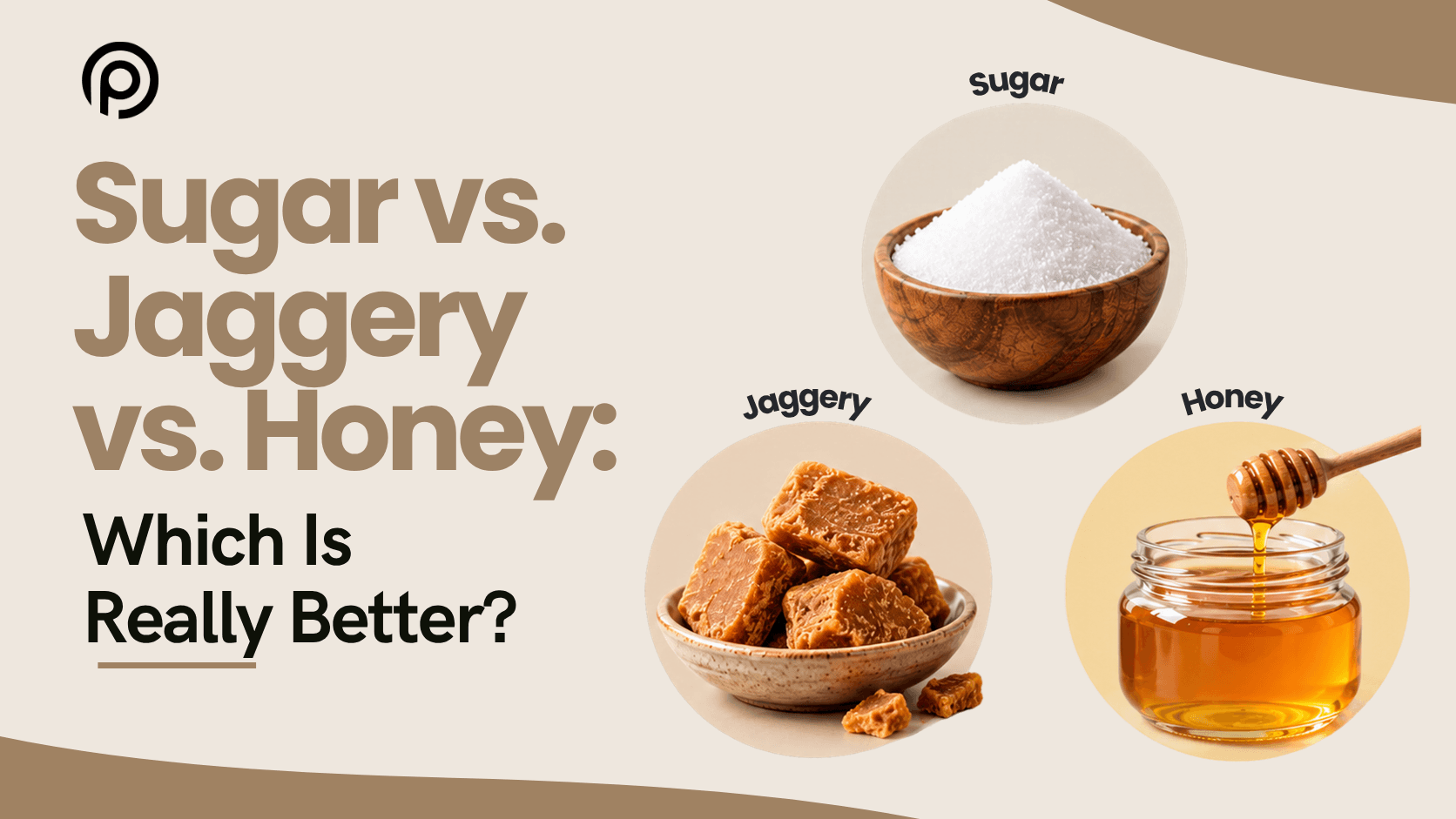
Sugar, jaggery and honey are three of the most commonly used sweeteners in Indian households. From adding sugar to morning tea and coffee to using jaggery in traditional sweets and honey in homemade drinks, these ingredients are part of everyday eating habits.
Many people believe that jaggery is automatically healthier than white sugar or that honey is a better option because it is natural. While these sweeteners have some nutritional differences, the actual health impact depends on their composition, quantity consumed and overall dietary habits.
Choosing a sweetener is not simply about deciding which one is natural or processed. It is about understanding what each option provides and how it affects your daily nutrition.
Let's compare sugar, jaggery and honey to understand which one deserves a place in a balanced diet.
1. Understanding the Three Common Sweeteners
Before comparing their nutritional value, it is important to understand how these sweeteners differ.
White Sugar
White sugar is usually produced from sugarcane or sugar beet. During processing, molasses and most naturally occurring plant components are removed, leaving primarily sucrose.
It provides energy in the form of carbohydrates but contains almost no meaningful amounts of vitamins, minerals or fibre.
White sugar is commonly used in:
- Tea and coffee
- Desserts and baked products
- Indian sweets such as halwa and kheer
- Packaged foods and beverages
Although white sugar is often considered unhealthy, consuming a small amount occasionally does not automatically make an otherwise balanced diet unhealthy. The bigger concern is excessive and frequent consumption.
Jaggery (Gur)
Jaggery is a traditional Indian sweetener generally made by concentrating sugarcane juice. Unlike refined white sugar, it retains some molasses and naturally occurring minerals because it undergoes less refining.
Jaggery contains small amounts of minerals such as iron, potassium and calcium. However, these quantities vary depending on the production process and product quality.
Jaggery is commonly used in:
- Chikki and traditional sweets
- Gur-based laddoos
- Jaggery tea
- Puran poli and other regional preparations
- Homemade desserts
Despite containing some minerals, jaggery is still primarily a source of sugar and should not be treated as a nutritional supplement or a replacement for iron-rich foods.
Honey
Honey is a natural sweet substance produced by bees from flower nectar. Its composition includes different sugars, mainly fructose and glucose, along with water and small amounts of other compounds.
Honey may contain trace amounts of antioxidants and other bioactive substances, depending on its floral source and processing.
It is commonly used in:
- Herbal teas and beverages
- Breakfast preparations
- Smoothies
- Homemade dressings
- Desserts and marinades
Although honey is often promoted as a healthier alternative to sugar, it still contributes free sugars to the diet.
2. Sugar vs Jaggery vs Honey: Nutritional Comparison
All three sweeteners provide energy, but their nutritional composition is slightly different.
| Nutritional FactorWhite SugarJaggeryHoney | |||
| Main components | Sucrose | Mostly sugars, including sucrose | Mainly fructose and glucose |
| Calories | Around 387 kcal/100 g | Around 380–390 kcal/100 g | Around 300–320 kcal/100 g |
| Carbohydrates | Almost entirely sugar | Mostly sugar | Mostly sugars |
| Minerals | Negligible | Small amounts | Trace amounts |
| Antioxidants | Negligible | Variable, generally limited | Variable, depending on source |
| Fibre | None | Negligible | None |
| Blood sugar impact | Raises blood glucose | Raises blood glucose | Raises blood glucose |
Values are approximate and may vary depending on the product, moisture content and processing method.
Honey contains fewer calories per 100 grams than sugar and jaggery, partly because it contains more water. However, a teaspoon of honey and a teaspoon of sugar are not necessarily equivalent in sweetness or weight.
The important takeaway is that none of these sweeteners should be considered a significant source of essential nutrients.
3. Is Jaggery Healthier Than White Sugar?
Jaggery is often recommended as a healthier replacement for refined sugar, especially in traditional Indian households.
There is a reason behind this perception. Jaggery undergoes less refining and retains small quantities of minerals that are largely removed during white sugar production.
However, this difference does not make jaggery a health food.
Both jaggery and white sugar contain a high proportion of sugars and provide a similar amount of energy by weight.
Some common misconceptions about jaggery include:
Myth 1: Jaggery does not increase blood sugar.
Jaggery contains carbohydrates that are digested and absorbed, contributing to an increase in blood glucose levels. It is not a sugar-free or diabetes-friendly alternative.
Myth 2: Jaggery helps prevent anaemia.
Although jaggery may contain some iron, the amount varies and is generally not sufficient to treat or prevent iron deficiency. Foods such as lentils, beans, leafy vegetables and appropriate iron-rich animal foods are more useful dietary sources.
Myth 3: Jaggery can be consumed freely because it is natural.
Natural does not mean unlimited. Excessive jaggery consumption can increase total calorie and added sugar intake, just like excessive consumption of white sugar.
Jaggery can certainly be enjoyed as part of traditional recipes, but portion control remains important.
4. Is Honey Better Than Sugar?
Honey is frequently marketed as a healthier alternative to refined sugar. It has a distinct flavour, contains trace bioactive compounds and may offer a different taste profile in food and beverages.
However, honey is still a concentrated source of sugars.
There are a few differences worth understanding:
- Honey generally contains fewer calories per 100 grams than dry sugar because of its higher water content.
- It contains mainly fructose and glucose rather than sucrose.
- Its natural flavour can sometimes provide sufficient sweetness with a smaller quantity.
- Some varieties contain small amounts of antioxidant compounds.
However, honey still contributes free sugars and can increase blood glucose levels.
It should not be considered a treatment for diabetes, weight management or other health conditions.
One additional point: honey should never be given to infants below 12 months because of the risk of infant botulism.
For adults and older children, honey can be included in the diet if consumed in reasonable quantities.
5. How Do Sugar, Jaggery and Honey Affect Blood Sugar?
One of the most important considerations when choosing a sweetener is its effect on blood glucose.
All three options contain sugars that can contribute to a rise in blood glucose after consumption.
The response depends on several factors, including:
- The quantity consumed
- The overall carbohydrate content of the meal
- Whether the sweetener is consumed alone or with other foods
- Individual insulin sensitivity
- Physical activity and metabolic health
For example, adding jaggery to a cup of tea does not make the drink suitable for someone with diabetes simply because jaggery is less refined.
Similarly, replacing white sugar with honey does not eliminate the need to monitor carbohydrate and sugar intake.
People with diabetes should consider the total carbohydrate content of meals and follow an individualised nutrition plan recommended by their healthcare professional.
It is also important not to judge a sweetener's suitability based on its glycaemic index alone. The quantity consumed and the complete meal pattern matter.
6. Which Sweetener Is Better for Weight Management?
If your goal is weight management, replacing white sugar with jaggery or honey is unlikely to make a major difference on its own.
All three provide concentrated sources of energy.
For example:
- Adding two teaspoons of sugar to tea contributes extra calories.
- Replacing those teaspoons with jaggery does not remove those calories.
- Adding honey to smoothies or warm beverages can also increase overall energy intake.
Weight management depends on your overall eating pattern, physical activity, sleep, consistency and total energy intake.
Instead of focusing only on changing sweeteners, consider these practical habits:
- Gradually reduce the amount of sugar added to tea and coffee.
- Avoid adding multiple sweeteners to the same meal.
- Choose whole fruits when you want something sweet.
- Reduce frequent consumption of sugary beverages.
- Pay attention to hidden sugars in packaged foods.
- Build balanced meals with adequate protein, fibre and healthy fats.
Small, sustainable changes are generally more useful than completely replacing one sweetener with another.
7. Which Sweetener Should You Use in Everyday Indian Meals?
The best choice depends on the recipe, taste preference and how much you use.
Here are some practical ways to include these sweeteners in everyday meals.
For tea and coffee: You can use a small quantity of sugar, jaggery or honey according to your preference. Gradually reducing the overall sweetness is a useful habit.
For traditional Indian sweets: Jaggery can be used in recipes such as til laddoos, chikki and gur-based desserts. Remember that it still contributes sugar and calories.
For smoothies: A ripe banana, dates or other whole fruits can add sweetness. If you prefer honey, use a small quantity.
For breakfast: Instead of regularly adding sugar to oats or cereals, try fresh fruits, cinnamon or a small amount of nuts to improve flavour.
For homemade desserts: Experiment with reducing the total sweetener used in recipes rather than assuming that switching to jaggery or honey makes the dessert automatically healthier.
The goal is not to eliminate every sweet ingredient but to develop a more mindful approach to sweetness.
8. How Much Added Sugar Should You Consume?
The World Health Organization recommends reducing free sugar intake to less than 10% of total daily energy intake. A further reduction to below 5% may provide additional health benefits.
For someone consuming approximately 2,000 calories per day:
- Less than 50 grams of free sugars per day corresponds to the 10% recommendation.
- Less than 25 grams per day corresponds to the 5% recommendation.
Free sugars include sugars added to foods and beverages, as well as sugars naturally present in honey, syrups and fruit juices.
These recommendations are general guidelines, not individual prescriptions. Your nutritional needs may differ depending on your health status and energy requirements.
It is also important to remember that free sugar intake comes from multiple sources, not just the sweetener added to tea or homemade food.
Biscuits, packaged juices, breakfast cereals, desserts, flavoured yoghurts and sweetened beverages can contribute significantly to daily sugar intake.
9. Common Mistakes People Make While Choosing Sweeteners
Even people who try to eat healthily can develop misconceptions about natural sweeteners.
Here are some mistakes worth avoiding:
1. Assuming natural means healthy
Honey and jaggery may be less refined than white sugar, but both still contribute significant amounts of sugar.
2. Ignoring portion sizes
A large serving of jaggery or honey can contribute more sugar and calories than a small serving of white sugar.
3. Using honey for every health concern
Honey is not a substitute for a balanced diet, medical treatment or appropriate nutrition planning.
4. Forgetting about hidden sugars
Reducing sugar in tea while frequently consuming packaged snacks and sweetened drinks may not significantly reduce total sugar intake.
5. Expecting one ingredient to improve overall health
No single sweetener can compensate for an otherwise unbalanced dietary pattern.
Understanding these mistakes can help you make better everyday food choices without unnecessary restrictions.
10. So, Which Is Really Better: Sugar, Jaggery or Honey?
There is no universally healthiest winner among sugar, jaggery and honey.
Each has a slightly different composition, flavour and culinary use.
- White sugar: A convenient sweetener with very little nutritional value.
- Jaggery: A traditional, less-refined sweetener that contains small amounts of minerals but remains high in sugar.
- Honey: A natural sweetener containing trace bioactive compounds, but it still contributes free sugars.
If you enjoy traditional Indian foods, you do not necessarily need to avoid jaggery. If you prefer honey in your breakfast, you can include it in moderation. Similarly, occasional use of white sugar can fit into an overall balanced diet.
What matters most is the total amount of free sugar you consume and the quality of your overall dietary pattern.
Instead of searching for a perfect sugar replacement, focus on gradually reducing excessive sweetness, eating more whole foods and developing sustainable eating habits.
Frequently Asked Questions (FAQs)
1. Is jaggery healthier than white sugar?
Jaggery contains small amounts of minerals that are largely absent in refined white sugar. However, both are high in sugars and provide similar calories by weight. Jaggery should still be consumed in moderation.
2. Can people with diabetes eat jaggery?
Jaggery can increase blood glucose levels and is not a diabetes-friendly substitute for sugar. People with diabetes should monitor their total carbohydrate intake and follow advice from their healthcare professional.
3. Is honey better than sugar for weight loss?
Honey contains fewer calories per 100 grams than dry sugar, mainly because of its water content. However, it still provides free sugars. Replacing sugar with honey alone is unlikely to produce meaningful weight loss.
4. Does jaggery contain iron?
Jaggery may contain small quantities of iron, but the amount varies considerably. It should not be relied upon to correct iron deficiency or treat anaemia.
5. Can I replace sugar with honey in my daily tea?
Yes, you can use honey according to your taste preference. However, honey still contributes free sugars, so the quantity should remain moderate.
6. Which sweetener is best for people trying to eat healthy?
There is no single best option. The most useful approach is to reduce excessive consumption of all sweeteners and focus on balanced meals, whole fruits and minimally processed foods.
7. Are dates healthier than sugar and jaggery?
Whole dates provide fibre and some micronutrients along with natural sugars. They can be a useful alternative in certain recipes, but they still contribute carbohydrates and calories. Date syrup and date sugar should not be confused with whole dates.
Final Takeaway
Sugar, jaggery and honey may look different, but all three contribute sugars to your diet. Jaggery offers small amounts of minerals, while honey contains trace bioactive compounds, but neither should be treated as a freely consumable health food.
The healthiest approach is not necessarily to replace one sweetener with another. It is to become mindful of portion sizes, reduce excessive added sugar and build a balanced dietary pattern that you can maintain over time.
Save this guide for your next grocery trip and follow PayByCal for practical, evidence-informed nutrition advice.
Download the application now
https://paybycal.com/download.html
- jaggery vs sugar vs honey
- is jaggery healthy
- honey vs sugar calories
- healthier sweetener India
- natural sweeteners
- refined sugar alternatives
- nutrition facts
This article is for general education and is not medical advice. Please consult a qualified healthcare professional about your individual needs.