Nutrition10 min read
Digital Health Blueprint: Marketing & Pricing Virtual Diet Packages
Step-by-step business framework for creators and freelancers to package, price, and sell online diet programs.
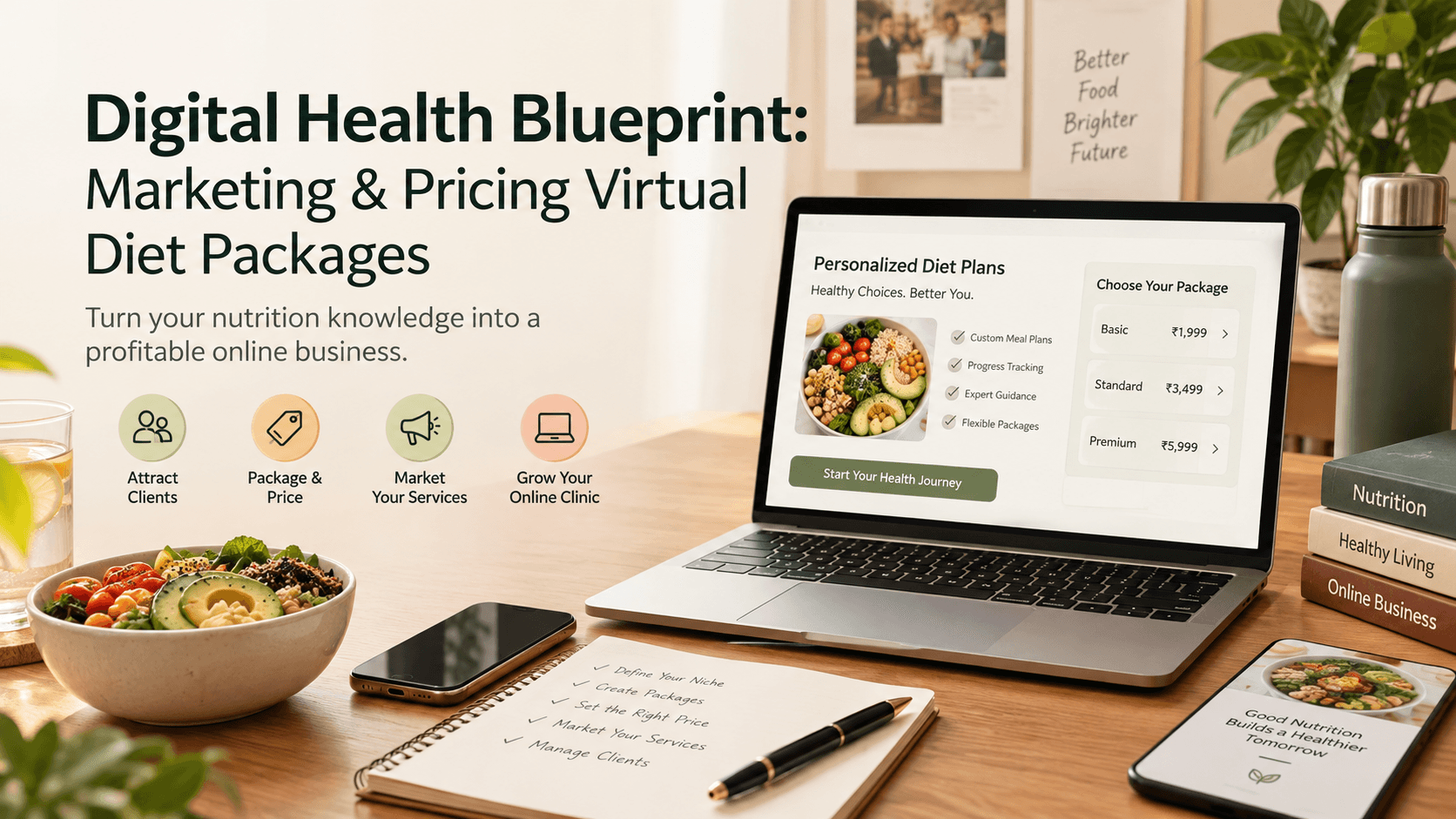
Digital Health Blueprint: Marketing & Pricing Virtual Diet Packages
Turn Your Nutrition Knowledge into a Profitable Online Business
The growing demand for convenient, personalized health and nutrition guidance has created exciting opportunities for nutrition professionals, health influencers, wellness coaches, and freelancers. With the right strategy, you can transform your nutrition knowledge into structured online diet packages, build a loyal client base, and develop a sustainable digital business.
However, creating diet charts is only one part of the process. Building a successful virtual nutrition business requires much more than sharing meal plans. You need a clear service offering, a suitable pricing strategy, an effective marketing approach, a smooth client onboarding process, and a reliable system for managing your online consultations.
Whether you are an established nutrition professional, a health content creator looking to monetize your audience, or someone planning a career switch into the wellness industry, this digital health blueprint will help you understand how to package, market, price, and manage virtual diet consulting services effectively.
1. Identify Your Target Audience and Niche
Before creating your online diet packages, identify the specific audience you want to serve. Trying to help everyone with the same offer can make your services difficult to position and market.
Instead, focus on a clearly defined audience and understand its needs, challenges, and goals.
For example, your target audience could include:
- Busy professionals looking for practical, balanced meal plans.
- Individuals seeking general weight-management guidance.
- Fitness enthusiasts who need nutrition support alongside their exercise routines.
- People who want help developing healthier eating habits.
- Families looking for convenient meal-planning guidance.
- Health-conscious individuals who prefer virtual consultations over in-person appointments.
Choosing a niche helps you create relevant services, communicate your value more clearly, and attract clients who are more likely to benefit from your expertise.
Your services should match your qualifications and professional scope. Medical nutrition therapy and nutrition advice for specific health conditions should only be provided by appropriately qualified professionals.
2. Package Your Nutrition Services into Clear Offers
One of the most effective ways to sell online nutrition services is to convert individual consultations into clearly defined packages. Clients should understand what they are paying for, what is included, and what kind of support they can expect.
Rather than offering only a single diet chart, consider developing different service levels based on the amount of guidance and follow-up provided.
Basic Package
This package can be designed for clients who need an introduction to healthy eating and structured meal planning.
Possible inclusions:
- An initial consultation.
- A personalized meal plan, where appropriate.
- General nutrition and portion-planning guidance.
- A digital document containing recommendations.
- A brief follow-up to address questions.
Standard Package
A standard package can provide more ongoing support for clients who need help maintaining consistency.
Possible inclusions:
- An initial consultation and goal assessment.
- A customized nutrition plan.
- Scheduled progress reviews.
- Meal-planning adjustments when appropriate.
- Messaging support during defined hours.
- Practical educational resources.
Premium Package
A premium package can offer a more comprehensive experience for clients who want regular professional guidance.
Possible inclusions:
- Detailed initial assessment.
- Personalized nutrition planning.
- Multiple scheduled consultations.
- Regular progress monitoring.
- Meal-plan revisions when appropriate.
- Priority support within stated boundaries.
- A final review and recommendations for maintaining progress.
Clearly define the duration, number of consultations, response times, and limitations of every package. Avoid promising specific weight-loss results or guaranteed health outcomes.
3. Develop a Pricing Strategy That Reflects Your Value
Pricing your virtual diet packages can be challenging, especially when you are starting out. Charging too little may make it difficult to cover your time and operating expenses, while charging too much without demonstrating sufficient value can discourage potential clients.
A strong pricing strategy considers your expertise, the complexity of the service, the time required for each client, your target market, and the level of support included.
Start by calculating the time involved in consultations, assessments, meal-plan preparation, progress reviews, administrative tasks, and client communication. Then account for business expenses such as software, payment processing, marketing, and professional development.
You can also research comparable services in your market to understand typical pricing ranges. Use this research as a reference rather than copying another professional's prices.
Consider these pricing approaches:
Fixed-price packages: Charge one clearly stated amount for a defined service and duration.
Monthly subscriptions: Offer recurring access to scheduled consultations or ongoing educational support, with clear limits on what is included.
Tiered pricing: Provide basic, standard, and premium options to accommodate different budgets and support requirements.
Single consultations: Offer individual appointments for clients who want a one-time assessment or professional guidance.
Group programs: Where appropriate, deliver general nutrition education to multiple participants through workshops, webinars, or structured learning programs.
Your pricing should remain transparent. Explain what is included, whether follow-ups cost extra, how cancellations are handled, and when payment is due.
4. Build a Strong Personal Brand as a Nutrition Professional
In an increasingly competitive digital wellness market, clients need a reason to trust your services. A recognizable personal brand helps communicate your expertise, values, and approach to nutrition.
Start with a clear message explaining who you help, what problems you address, and how your services work.
For example, a qualified nutrition professional might position their service around practical meal planning for busy working adults. A health influencer with appropriate qualifications could focus on educational nutrition content and structured wellness programs.
Your brand should communicate credibility rather than rely on exaggerated promises.
To strengthen your online presence:
- Create a professional website or landing page.
- Use a consistent visual identity across social media platforms.
- Publish educational content supported by credible evidence.
- Clearly display your qualifications and relevant experience.
- Explain your consultation process and service boundaries.
- Share genuine client feedback only with appropriate permission.
- Make it easy for potential clients to contact you or book a consultation.
Trust is built through accuracy, transparency, professionalism, and consistent communication.
5. Create a Content Marketing Strategy That Attracts Clients
Content marketing allows health influencers and nutrition professionals to demonstrate their expertise before asking potential clients to purchase a service.
Instead of promoting your packages in every post, create useful educational content that answers common questions and helps your target audience understand the value of professional nutrition guidance.
Examples include:
- Healthy meal-planning tips for busy professionals.
- Grocery shopping and food-preparation guides.
- Educational posts about balanced meals.
- Common nutrition misconceptions explained using reliable evidence.
- Demonstrations of how to organize weekly meal plans.
- Videos explaining what clients can expect during virtual consultations.
- General wellness habits that support consistency.
Use a mix of short-form videos, carousel posts, blog articles, email newsletters, and live educational sessions.
Each piece of content should have a purpose. Educational posts build awareness, practical guides encourage engagement, and service-related content helps interested followers understand how to work with you.
Include a simple call to action, such as inviting readers to explore your services, download a meal-planning guide, or book an introductory consultation.
Avoid fear-based marketing, misleading before-and-after claims, and statements suggesting that one diet is suitable for everyone.
6. Build a Simple Sales Funnel for Your Online Diet Packages
A sales funnel guides potential clients from discovering your content to understanding your services and deciding whether to purchase a package.
You do not need a complicated marketing system to begin. A simple, organized process can be effective.
Step 1: Attract attention. Publish helpful content on social media, your website, or relevant online communities.
Step 2: Offer additional value. Provide a useful resource, such as a general meal-planning checklist, nutrition education guide, or webinar.
Step 3: Introduce your services. Direct interested people to a landing page that explains your packages, qualifications, process, and pricing.
Step 4: Encourage bookings. Provide a straightforward way to schedule an introductory call or consultation.
Step 5: Convert interested prospects. Explain the most suitable service based on their needs, eligibility, and your professional scope. Make the price and terms clear before payment.
Step 6: Continue the relationship. Deliver the service professionally and, where appropriate, offer renewals or follow-up packages based on client needs rather than pressure.
Track how many people visit your website, inquire about your services, book consultations, and become paying clients. These figures can help you identify which marketing activities are worth improving.
7. Simplify Client Onboarding and Virtual Consultations
A smooth onboarding process creates a professional first impression and reduces administrative work.
Once a client purchases a package, provide clear instructions about the next steps. This may include completing an intake form, selecting an appointment time, reviewing service terms, and preparing for the initial consultation.
An effective onboarding process can include:
- A welcome email with package details.
- A secure client intake form.
- Appointment scheduling and reminders.
- Consent and service agreements where required.
- Relevant health and lifestyle questionnaires.
- Clear communication and cancellation policies.
- Secure storage of client information.
- A defined process for progress reviews.
Collect only the information necessary for the service, and protect sensitive client data through appropriate access controls and secure systems.
During virtual consultations, communicate clearly, listen to client concerns, and establish realistic expectations. Explain how progress will be reviewed and how recommendations may change over time.
Professional boundaries are also important. Define your usual response times, messaging hours, consultation limits, and procedures for referring clients to another qualified healthcare professional when their needs fall outside your expertise.
8. Use Digital Tools to Manage Your Online Nutrition Business
Running a virtual clinic can involve scheduling, payments, client communication, document management, follow-ups, and progress tracking. Managing everything manually can become difficult as your client base grows.
Digital tools can help simplify these activities and create a more consistent experience.
Depending on your business requirements, consider tools for:
- Online appointment scheduling.
- Video consultations.
- Payment collection and invoices.
- Client onboarding and forms.
- Meal-plan and educational resource delivery.
- Progress tracking and follow-up reminders.
- Email marketing and client relationship management.
- Website analytics and sales reporting.
Choose tools based on usability, cost, privacy, and the needs of your clients. Avoid collecting sensitive health information through systems that are not appropriate for that purpose.
A well-organized digital workflow can help you spend less time on repetitive administration and more time delivering quality services.
9. Understand Legal, Ethical, and Professional Responsibilities
A successful nutrition business must be built on more than sales and marketing. Professional responsibility, client safety, and legal compliance are essential to long-term growth.
Before offering services, verify the qualifications, registrations, or licences required for your location and the services you intend to provide. Requirements can vary depending on the jurisdiction, professional title, and type of nutrition service.
Important considerations include:
- Professional scope: Provide advice only within your training and legal scope of practice.
- Privacy and data protection: Explain how client information is collected, used, stored, and protected.
- Informed consent: Ensure clients understand the service, its limitations, and relevant terms.
- Transparent pricing: Clearly disclose fees, refund conditions, cancellation policies, and additional charges.
- Advertising standards: Avoid deceptive testimonials, unsupported health claims, and guaranteed outcomes.
- Client safety: Recognize when a client requires assessment or treatment from an appropriately qualified healthcare professional.
- Online service requirements: Check applicable rules for serving clients in different regions or countries.
If you operate in India, review the professional requirements and applicable regulations relevant to your qualifications and service model. Obtain appropriate legal or professional advice when necessary.
Ethical practices protect clients, strengthen trust, and help establish a more sustainable business.
10. Measure Performance and Improve Your Packages
Launching your online nutrition business is only the beginning. To grow sustainably, review your performance regularly and identify opportunities to improve your services.
Start by tracking a few meaningful indicators:
Inquiry-to-booking rate: How many interested prospects schedule a consultation?
Consultation-to-purchase rate: How many suitable prospects purchase a package after learning about your services?
Average revenue per client: How much revenue does each client generate over a defined period?
Client retention rate: How many clients return for appropriate follow-up services or renewals?
Client satisfaction: Are clients finding the process clear, supportive, and useful?
Time spent per client: Are your packages priced appropriately for the work involved?
Use these insights to improve your website messaging, revise package inclusions, simplify onboarding, and refine your marketing strategy.
For example, if many people inquire but few purchase, your pricing, service descriptions, or booking process may need improvement. If clients are satisfied but your workload is too high, you may need to adjust package limits or administrative systems.
Growth should not come at the expense of service quality. Expand your client base at a pace that allows you to maintain professional standards and provide appropriate support.
Conclusion: Build a Sustainable Virtual Nutrition Business
Turning nutrition knowledge into a successful online business requires a combination of professional expertise, thoughtful service design, transparent pricing, consistent marketing, and effective client management.
Start by selecting a clear niche, developing packages that meet genuine client needs, and setting prices that reflect the time and value involved. Build trust through educational content, create a simple sales funnel, and establish an organized onboarding process. As your business grows, use suitable digital tools and performance data to improve the client experience.
Most importantly, prioritize evidence-based guidance, ethical marketing, privacy, and professional responsibility. Sustainable growth comes from delivering meaningful value rather than promising unrealistic results.
Whether you are a health influencer exploring creator monetization, a freelancer developing a new service, or a qualified nutrition professional building a virtual clinic, a structured approach can help you turn your expertise into a more organized and scalable digital offering.
Ready to take the next step? Explore the educational resources and business frameworks available through NHHA, and start building a clearer roadmap for your online nutrition services with ouur team
Enroll now https://learn.nhha.in/nutration-lp/
- Sell diet plans
- online clinic
- creator monetization
- price packages
This article is for general education and is not medical advice. Please consult a qualified healthcare professional about your individual needs.