Healthy Lifestyle6 min read
Water Fasting and Autophagy: What Does It Really Mean?
Autophagy is frequently discussed with fasting. Understand what the term actually means without exaggerated claims.
Water Fasting and Autophagy: What Does It Really Mean?
Understanding Autophagy: Your Body's Natural Recycling System
Autophagy is a natural process that helps the body maintain healthy cells by breaking down and recycling damaged or unnecessary cellular components. The word "autophagy" comes from Greek, meaning "self-eating." Although the term may sound unusual, it describes an important biological activity that supports normal cellular maintenance.
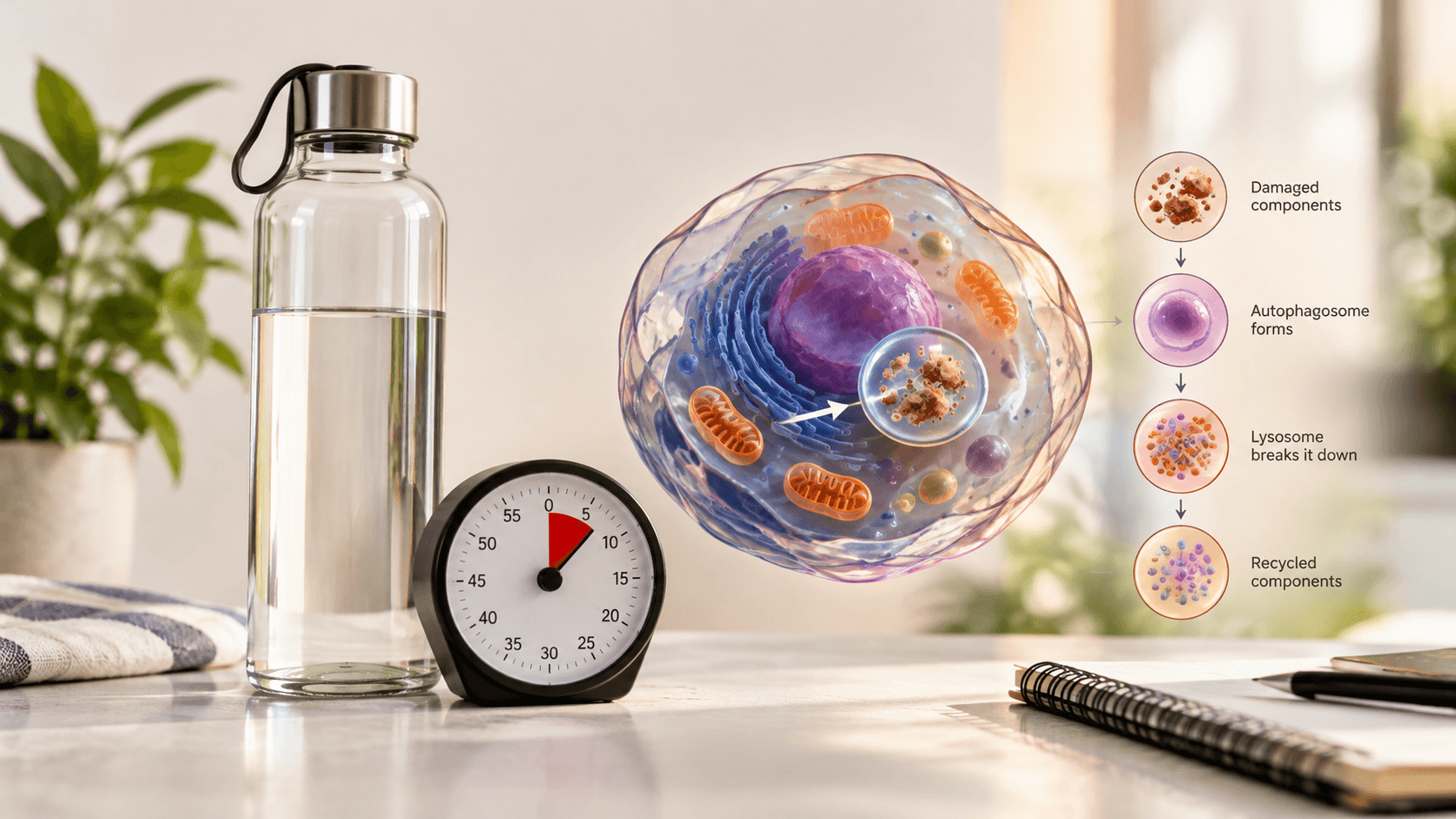
During autophagy, cells identify certain damaged proteins, worn-out structures, and other components that are no longer functioning properly. These materials are transported to structures called lysosomes, where they are broken down into smaller components. Some of these materials can then be reused by the cell to support other functions.
Rather than being a process that happens only during fasting, autophagy is continuously active at different levels throughout the body. It plays a role in cellular quality control, adaptation to stress, and maintaining normal cell function.
How Is Autophagy Connected to Water Fasting?
Water fasting involves temporarily avoiding food and consuming water without other calorie-containing beverages or foods. During this period, the body experiences changes in nutrient availability, energy metabolism, and hormonal signalling.
When food intake decreases, the body adjusts several cellular pathways responsible for managing energy and nutrients. Two important pathways involved in this process are:
- AMPK (AMP-activated protein kinase): This pathway helps cells respond to low energy availability and supports processes involved in energy balance.
- mTOR (mechanistic target of rapamycin): This pathway responds to nutrient availability and plays an important role in regulating cell growth, protein synthesis, and other cellular activities.
Changes in these pathways may influence autophagy. Reduced nutrient availability can support conditions that encourage autophagy in certain tissues and experimental settings.
However, fasting is only one of several factors that influence this process. Exercise, cellular stress, nutrient status, and normal biological regulation can also affect autophagy.
What Happens Inside Your Cells During Autophagy?
Autophagy works through a series of coordinated steps that help cells manage unwanted or damaged components.
1. Identifying Cellular Components
Cells identify proteins, structures, or other materials that are damaged, unnecessary, or no longer functioning properly.
2. Forming an Autophagosome
A membrane structure develops around the selected cellular material, creating a compartment called an autophagosome.
3. Breaking Down Unwanted Materials
The autophagosome combines with a lysosome, which contains enzymes that break down the enclosed materials.
4. Recycling Useful Components
The resulting smaller molecules can be reused by the cell for energy production, maintenance, and other biological activities.
This recycling system helps cells maintain their internal environment and respond to changing conditions.
Does Water Fasting Automatically Increase Autophagy?
Fasting is often associated with increased autophagy because reduced nutrient availability can influence the cellular pathways involved in this process.
Research involving animals and laboratory cell models has provided useful information about how fasting and nutrient restriction may affect autophagy. However, the findings cannot always be directly applied to humans.
In humans, measuring autophagy is challenging because the process varies between tissues and changes over time. A measurement from one tissue may not represent what is happening throughout the entire body.
This is why there is no scientifically established fasting duration that guarantees a particular level of autophagy in every person.
Is There a Specific Time When Autophagy Starts?
One common claim on social media is that autophagy begins after a fixed number of fasting hours, such as 16, 18, 24, or 48 hours.
However, the reality is more complicated.
Autophagy is not an on-and-off switch. It is a continuously regulated cellular process that can change depending on several factors, including:
- Previous eating patterns and nutrient availability.
- Physical activity and exercise levels.
- Individual metabolic conditions.
- Sleep and circadian rhythms.
- The type of tissue being studied.
- Overall health and biological differences.
Although fasting duration can influence metabolic changes, there is currently insufficient human evidence to establish an exact hour at which autophagy begins or reaches its maximum.
Therefore, claims about guaranteed autophagy timelines should be treated cautiously.
Potential Biological Roles of Autophagy
Autophagy is important for normal cellular functioning. Scientific research has linked it to several biological activities.
Cellular Maintenance: It helps remove damaged proteins and cellular structures, supporting the maintenance of healthy cells.
Protein Recycling: It allows cells to break down and reuse certain proteins and other cellular materials.
Response to Stress: Autophagy helps cells adapt to different forms of stress, including changes in nutrient availability.
Cellular Quality Control: By helping remove dysfunctional components, autophagy contributes to the regulation of cellular health.
Immune System Functions: Autophagy participates in certain immune responses, including the handling of intracellular microorganisms and the regulation of inflammation.
It is important to understand that these biological roles do not mean water fasting has been proven to prevent diseases, reverse ageing, or provide guaranteed health benefits through autophagy.
What Does Human Research Actually Say?
Much of the detailed scientific understanding of autophagy comes from laboratory experiments and animal studies. These studies have helped researchers understand how cells respond to nutrient restriction and metabolic stress.
Human research is more difficult because autophagy cannot be easily measured across all organs and tissues in a living person. Researchers also need to distinguish between increased autophagy activity and changes in the production or breakdown of cellular components.
Consequently, although fasting-related changes in nutrient-sensing pathways are scientifically recognised, the exact relationship between different fasting durations and autophagy in humans remains an active area of research.
Future studies may help clarify how different eating patterns influence autophagy and whether these changes translate into meaningful long-term health outcomes.
Is Longer Water Fasting Better for Autophagy?
A longer fasting period does not automatically mean better cellular health.
Extended water fasting can increase the risk of dehydration, electrolyte imbalances, dizziness, low blood pressure, weakness, and other complications. Prolonged fasting may also contribute to nutritional deficiencies and loss of muscle mass.
People with diabetes, kidney or liver conditions, eating disorders, or other medical concerns may face additional risks. Pregnant or breastfeeding individuals and people taking certain medications should not attempt prolonged fasting without appropriate medical guidance.
It is also important to remember that the body has natural cellular maintenance mechanisms that function without deliberately undertaking prolonged fasts.
Can You Support Cellular Health Without Prolonged Fasting?
Yes. Supporting overall health does not require extreme fasting practices. Several everyday habits contribute to normal metabolic and cellular functioning.
- Eat a Balanced Diet: Include vegetables, fruits, whole grains, legumes, nuts, seeds, and adequate protein to support nutritional needs.
- Stay Physically Active: Regular physical activity supports metabolic health and influences several cellular signalling pathways.
- Prioritise Sleep: Consistent, adequate sleep supports normal hormonal and metabolic regulation.
- Maintain Healthy Eating Patterns: Focus on regular, sustainable eating habits rather than extreme dietary restrictions.
- Manage Stress: Healthy stress-management practices can support overall physical and metabolic well-being.
These habits support general health, although they should not be presented as guaranteed ways to increase autophagy.
Common Myths About Fasting and Autophagy
There is considerable confusion surrounding autophagy, especially in online fasting communities. Here are some common misconceptions:
Myth 1: Autophagy Starts Exactly After 16 Hours of Fasting.
Fact: There is no established universal fasting-hour threshold for autophagy in humans.
Myth 2: Longer Fasting Always Produces More Benefits.
Fact: Longer fasting can increase health risks and does not guarantee greater cellular benefits.
Myth 3: Autophagy Removes All Toxins From the Body.
Fact: Autophagy is a cellular recycling process, not a complete detoxification system.
Myth 4: Everyone Experiences the Same Autophagy Response.
Fact: Autophagy varies depending on tissue type, metabolic conditions, nutrient availability, and individual biology.
Myth 5: Water Fasting Is Necessary for Cellular Repair.
Fact: Autophagy is a normal biological process that occurs even when a person is eating regularly.
Final Thoughts: Understanding the Science Behind Fasting and Autophagy
Autophagy is an essential cellular recycling mechanism that helps the body maintain and regulate its cells. Water fasting is frequently discussed in connection with autophagy because changes in nutrient availability can influence cellular energy-sensing pathways.
However, the scientific understanding of fasting-induced autophagy in humans is still developing. Laboratory and animal research offers valuable insights, but it does not establish an exact fasting duration or guarantee specific health outcomes for people.
Instead of following extreme fasting schedules based on social-media timelines, it is better to understand the underlying science and prioritise sustainable health habits.
The key takeaway: Autophagy is a natural cellular process, not a benefit that switches on at a fixed fasting hour. Understanding the science is more important than chasing a fasting milestone.
Download the application nwo
https://paybycal.com/download.html
- autophagy
- fasting autophagy
- cellular repair
- fasting science
This article is for general education and is not medical advice. Please consult a qualified healthcare professional about your individual needs.